Yamaha upright piano
Big BrotherThe Yamaha upright piano is a secondhand instrument Pandora secured for Edison, originally to make visits to her home in Iowa possible for a brother who refused to come unless he could practice. During a later stay with Pandora’s family, the piano becomes the focus of an unexpected reversal: the man whose playing had once filled the household will not touch the keys, until Cody asks him to play and hears him transform a familiar song. The scene exposes both the depth of Edison’s musicianship and the limits of what his family can coax from him.
Acquisition and Earlier Visits
When Pandora was in her late twenties, a neighbor was giving the piano away for the price of removal. She obtained it for Edison because he would not visit her in Iowa unless he had an instrument on which to practice. It was therefore not simply a household furnishing: its presence helped make the visit possible, accommodating a condition Edison had set for coming.
The piano also recalls an earlier conflict. On a seminal visit, Edison played morning, noon, and night, and Fletcher eventually grew sick of the constant music. Pandora had reason to expect the piano to cause friction because Edison played so much. During the later stay, however, the problem had reversed: Edison would not play at all. The familiar object remained in the house, but the habit that had once made it seem almost unavoidable had disappeared.
Cody’s Request and Edison’s Return
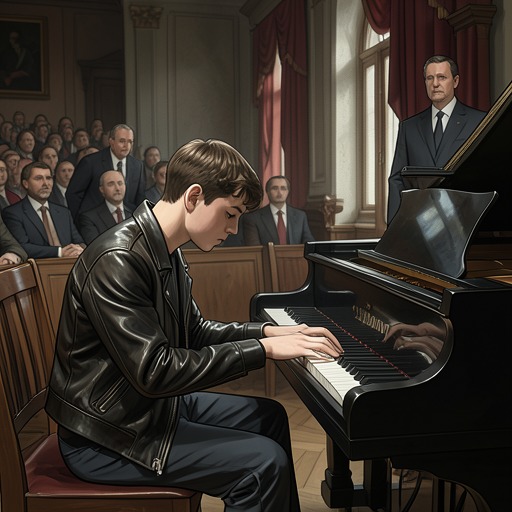
Cody remembered Edison staying with the family when she was little and playing often. She told him that his playing had been one of the main reasons she had decided to take piano, and implored him to show her how. Pandora privately doubted that Cody’s musical choice had really been inspired by her uncle, but Cody’s appeal nonetheless gave Edison a reason to sit down at the instrument. In his ratty black cardigan, he seemed almost swallowed by it; he rested his hands on Cody’s shoulders, then quickly removed them as if afraid he might be arrested, before agreeing to play.
The first verse came out straight, though Edison hesitated as he searched for the chords. By the refrain his playing had gained confidence. Pandora had seldom heard him play a familiar tune without, in her judgment, somehow messing it up. This time, hearing him play it plainly allowed her to recognize a quality she had missed: he was a fine pianist, not merely an idiosyncratic one. She stopped folding a napkin beside the battered maroon armchair and listened as the performance altered her understanding of both the song and its player.
Arrangement, Recognition, and Withdrawal
After establishing the melody, Edison began to bend the chords and carry them into a more dissonant range. The tune remained recognizable even as it moved away from the version Pandora knew, whose recorded arrangement she associated with yearning strings and excessive sentiment. Just as the changes threatened to become clamorous and lose the melody, he brought the original tune back for a final refrain: sweet and mournful, but without the violins. The performance led Pandora to hear the song’s underlying progression as coherent and even bettered by the detour; she also began to think that the song itself might be good at its core.
Cody burst into applause, and Pandora joined her. When Pandora softly asked why Edison did not play that way more often, he answered, “You got all night?” He then pushed the bench across the wooden floor with a shriek and refused to return to the piano, despite Cody’s cajoling. The brief performance thus opened a view of his ability without resolving why he had stopped playing or making music part of the household’s routine again.
Narrative Significance
The instrument links two different versions of Edison’s presence in Pandora’s home. On the earlier visit, his near-constant playing had irritated Fletcher; now the silence around the same piano makes Pandora wonder why Edison has withdrawn from it. Cody’s memories bridge that gap: she recalls the uncle who played when she was young and presents his musicianship as something that helped shape her own interest in piano.
The scene’s recognition arrives through an ordinary song played without the embellishment Pandora expected. By first making the melody clear, Edison lets her follow the later harmonic departures and hear their logic. The piano gives that recognition a concrete setting, but it does not promise a lasting change: applause and praise cannot keep Edison on the bench. The instrument therefore holds both the possibility of renewed connection and the boundary of what his family can ask of him.